My Grandparents Had a Word for What I Saw in Quixayá
by Neal Hegarty
Sep 14, 2026
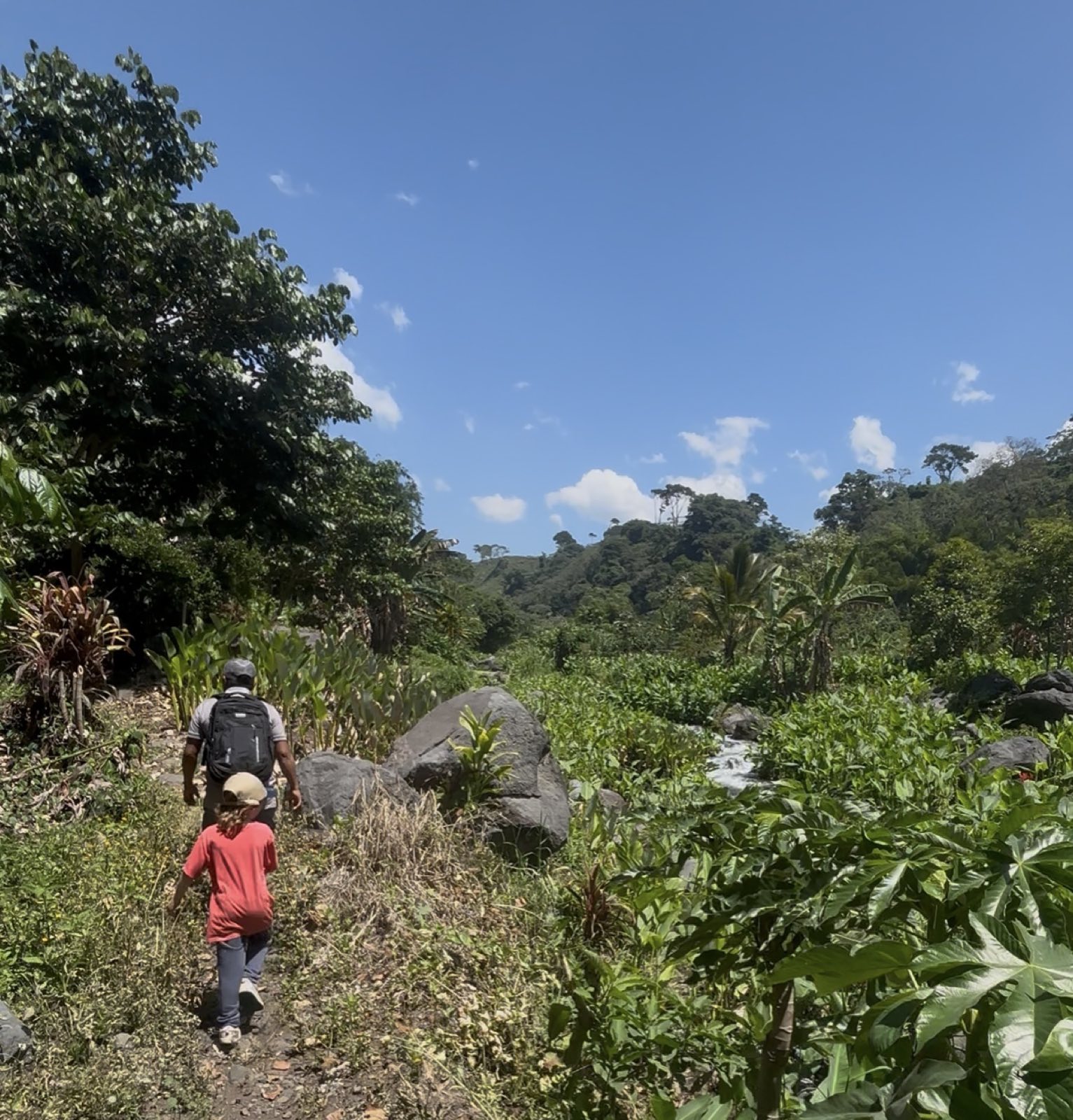
We took the interns and a few people from the community on a day trip this week, down to a village called Quixayá. I want to tell you about it, because almost everything I believe about this work I learned there.
Quixayá is an autonomous indigenous community that reclaimed its ancestral land in the early nineties. The civil war was still going. Land rights were the thing people were being killed over. Doing what they did, at that moment, took a kind of courage I don't think I've ever been asked for.
They did it anyway.
A few of their community leaders went on to train in permaculture design. One of them was my mentor for two years while I worked alongside him and wrote my thesis, back in 2013. What those men built afterwards is one of the most remarkable pieces of land I have ever stood on.
What they made
Quixayá sits in the Boca Costa, about 800 metres below Lake Atitlán. The same water that falls on our watershed emerges down there, bursting straight out of the rock, filtered clean by the volcano and in astonishing abundance.
That valley is mostly sugarcane. Theirs is not.
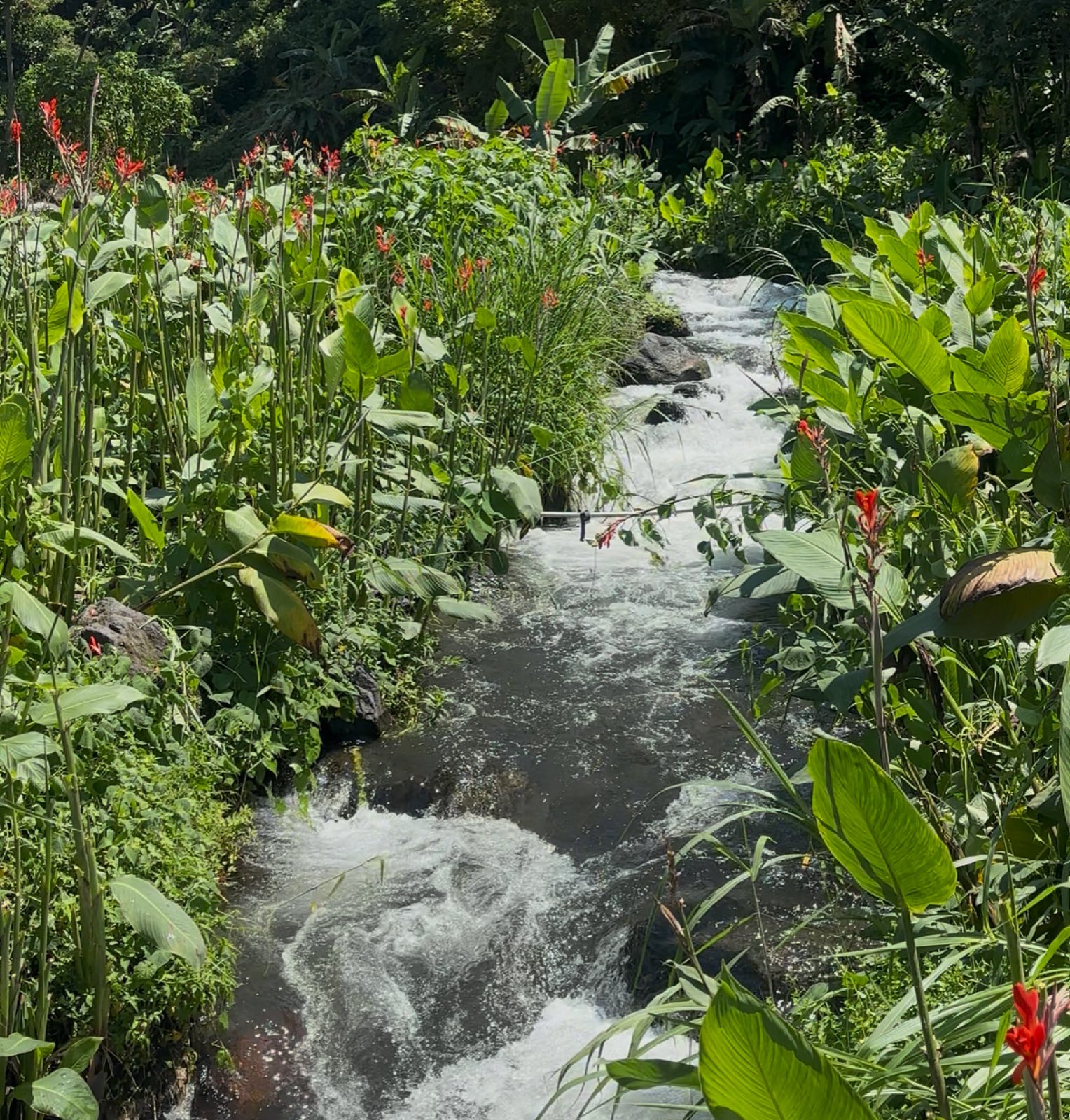
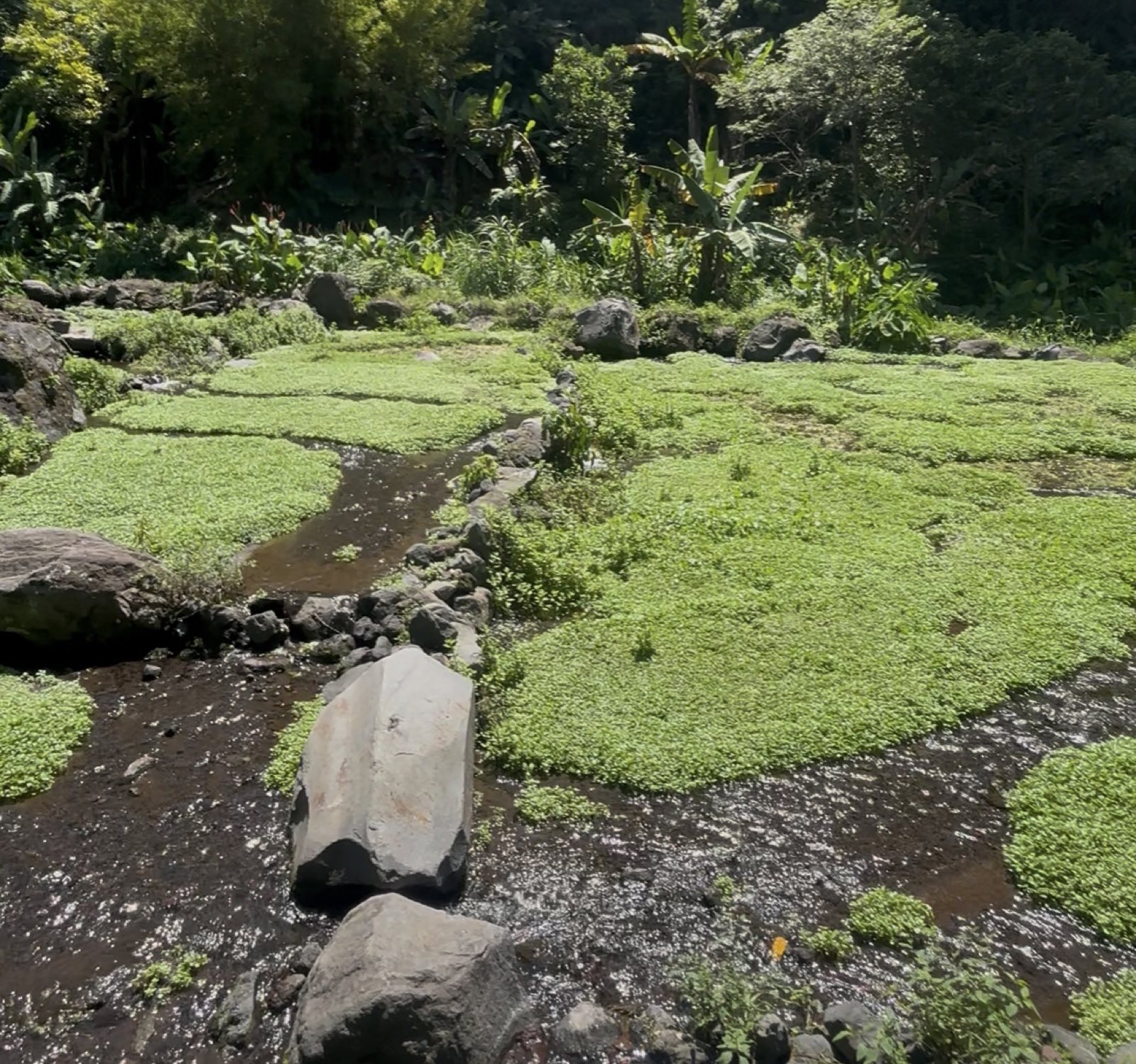
In the lowlands they took the river and spread it out, terracing it into a system of shallow channels where they grow watercress. Up the slope, food forests — forests where nearly everything growing is edible, at several heights at once — woven together with tilapia ponds and snail production. The water from the fish runs down through the trees, and the trees clean it on the way.
And then, because they could, they built swimming pools. Real ones, fed by spring water, cold and clear and beautiful.
They made a paradise. And they made all of it by hand.
The first thing they taught me
I arrived expecting instruments.
I thought earthworks at that scale would mean surveys, levels, calculations, plans. What I found was a group of men reading water the way you'd read a face.
A rock placed here. Wait, watch where it pools. A small trench there. A hole dug in the spot that just looks obvious once you've stood still long enough. Adjust. Watch again.
It is playful, it is closer to intuition than to engineering, and it has held for thirty years.
I'm not telling you to throw away your contour maps. I use them every day, and on a big property they'll save you from a catastrophe. But there is a kind of attention you can only build by standing in the water and moving a rock, and no software substitutes for it. Most people never build it because they never get their feet wet.
The second thing, and it's the important one
Here is how they got it all done.
Cuchubales.
A cuchubal is when the community turns out together to do one enormous job. Everyone comes. You plant the orchard, or the food forest, or the hedgerow, in a single push — one day, or a few.
It is not charity and it is not volunteering. It is a rotating obligation. Today we do yours. Next month you are at mine.
When I understood it properly, something clicked that had nothing to do with Guatemala. In Ireland we had exactly the same thing, and we still have the word for it.
Cuchubal — Quixayá, Guatemala
The whole community turns out for one enormous job. Today we do yours; next month you are at mine.
Meitheal — Ireland
The neighbours gather, the harvest comes in, the turf gets cut — and nobody counts hours, because next week it's your field.
Two cultures on opposite sides of the ocean, neither knowing anything about the other, landing on the same answer. That tells you something about how fundamental it is.
And here is why it matters so much for this kind of work.
A project like this nearly always has the same shape: one brutal, labour-intensive push at the start. Digging swales — the long level ditches that stop rain running off your land and make it soak in instead. Planting a thousand trees. Terracing a slope. That push is the reason most people never start, because one family cannot do it alone and paying for it is out of reach.
But it is a one-time job. Once that piece of land is shaped, it harvests its own water and its own sunlight, and it compounds every year after. You will never have to do it again.
So the whole problem reduces to one question: can you get enough hands together, once?
The superpower
Put those two lessons side by side and you get what I now think is the most valuable skill in this entire field.
Look at land the way a child does, and see the obvious leverage point. Where the water wants to go. Where one afternoon's work changes everything downstream.
Then organise a lot of people, teach them while they work, and get it done.
That combination has no ceiling. Someone who can do it is one of the most useful people in any community on earth, at any scale. And it costs nothing, which is the whole point — because the communities that need it most have nothing.
Fifteen years in, I am still getting better at it.
Which brings me to the honest part
You cannot learn this from a video.
You can learn design from a video. Genuinely — we teach it that way and it works.
But reading water with your feet in it, and standing in front of fifteen people holding shovels and turning them into something that works, are not information problems. They are practice problems.
The only way to learn is by doing. And the only way to get truly good is by teaching.
That is exactly why we built the programme here the way we did. People come, they work, they learn by doing real things on real land. And the ones who stay start teaching the ones who arrive after them — which is when they actually get good.
It is not a course with a farm attached. It is a living school, and Quixayá is a large part of the reason it exists in that shape.
We are going back, and we film every one of these trips.
If that is the thing you have been looking for, come and find out. A couple of weeks or several months, whatever you've got.
Neal